
Purple Hen began in 2001 when Rick Lacey and Maira Vitols purchased the property – 32 hectares of prime grazing land. Planting of vines began in January 2002 with the first vintage in 2004. An on-site winery was established in 2005 and the Cellar Door opened at Easter 2006.

In the ensuing years we have expanded the vineyard to its current 12 hectares and established an enviable record for producing elegant and strongly varietal wines – winning over 200 Medals and Trophies at wine shows in Australia.

Phillip Island is best known for its tourist attractions such as the penguins, seals and koalas. We hope it will become increasingly recognised for possessing one of the best climates in Australia for the growing of quality wines.

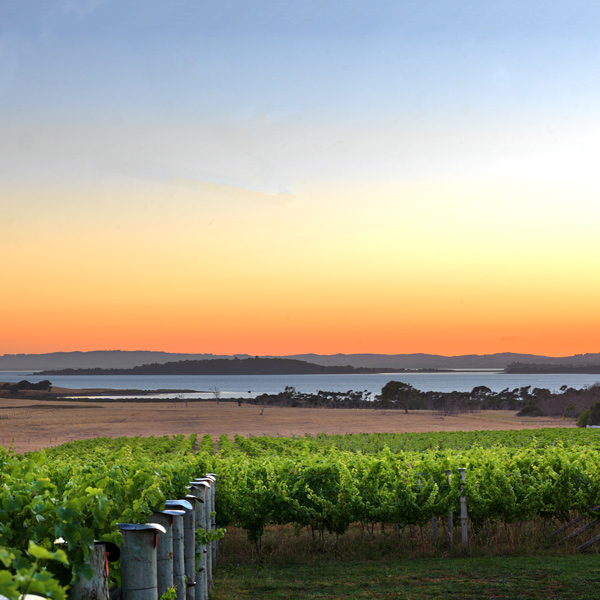
We are located on a small peninsula on Phillip Island, overlooking the Bay of Western Port with beautiful views of Swan Inlet, Churchill Island and Denne Bight.

Climate

This is a thoroughly maritime location – just 500 metres from the Bay and a little over two kilometres from Bass Straight. The great benefits for winegrowing of such a maritime climate are its moderating effect on temperatures and higher relative humidity during ripening.

Ripening begins in mid-summer and runs to early autumn. During this period, temperatures are mild and free of extreme heat – the days being cooled and nights warmed by the closeness to the Bay and ocean. Over the peak summer months of January – February, on average the Island experiences just 2 days with temperatures above 35º C.

The result is a mild climate capable of ripening a wide range of varieties and producing strongly varietal character. Red wines are noted for their soft and supple tannins – a feature of maritime climates.

Region

Officially, Phillip Island is designated to be part of the Gippsland Wine Region. However, Gippsland is a large and diverse region. It encompasses a number of distinct climatic sub-regions and within these Phillip Island with its strongly maritime climate is somewhat unique.

Industry standard measures of warmth over the growing season (degree day summation) indicate that Phillip Island is typically warmer than most of Gippsland. This is achieved by way of the maritime impact of its cooler day time temperatures being more than offset by warmer nights.

Viticulturally we are a more like the warmer sites on the Mornington Peninsula.
 

Vineyard

Currently we have 12 hectares of vineyard at Purple Hen. The largest planting is Pinot Noir followed by Shiraz. Other varieties are Chardonnay, Sauvignon Blanc, Pinot Gris, Riesling, Viognier, Cabernet Sauvignon and Malbec.

Terroir of the site is dominated by the moderating impact of the Bay and the basalt derived soils – clay loam topsoils over clay subsoils. Climatically, the site is ideal for Pinot Noir, with summer peaks in temperature being limited by the cooling effect of the Bay. That said, the site is quite vigorous and the vineyard requires considerable time and effort in canopy control, leaf plucking and the like. A feature of all the wines is their varietal clarity and for the reds, their supple tannins.

Winemaking

Winemaking at Purple Hen is a team affair – both in terms of people and in the close integration between vineyard and winery.

Dom Kearton and Rick are responsible for winemaking and the operations of the winery. But in producing quality wines, the work done in the vineyard is as much or more important to that in the winery. Adam, Dom and Rick are all involved in vineyard and winery aspects of the business.

When it comes time to consider wines and blends our cellar door team is also actively involved. In blind tastings and wine decisions the more palates and perspectives the better.

‘Winemaker’ is a term we dont really identify with. It suggest a degree of intervention and fabrication to which we do not aspire. Our role is more akin to that of a ‘wine mid-wife’ – intervening if things go awry, but by and large, assisting nature to take its course. Good site selection, management of the vines and the timing and management of harvest (i.e. careful and intelligent hand harvesting) are the keys to superior wines. The role of winemaking is to ensure that the potential created in the vineyard is fully reflected in the wine in the bottle.