Climate
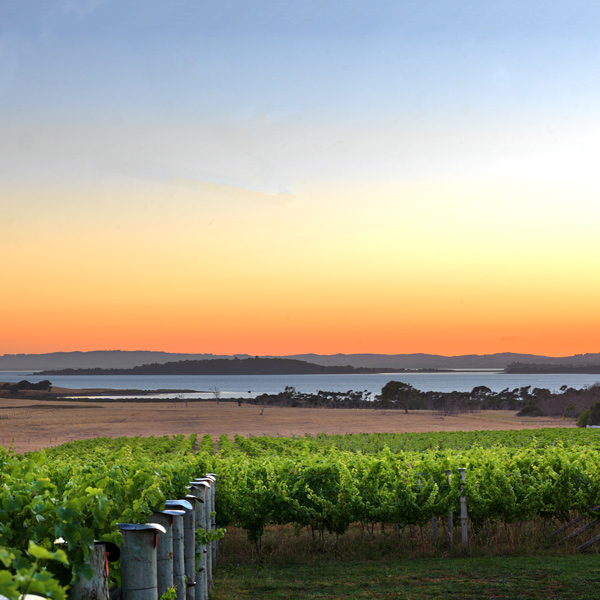
This is a thoroughly maritime location – just 500 metres from the Bay and a little over two kilometres from Bass Straight. The great benefits for winegrowing of such a maritime climate are its moderating effect on temperatures and higher relative humidity during ripening.
Ripening begins in mid-summer and runs to early autumn. During this period, temperatures are mild and free of extreme heat – the days being cooled and nights warmed by the closeness to the Bay and ocean. Over the peak summer months of January – February, on average the Island experiences just 2 days with temperatures above 35º C.
The result is a mild climate capable of ripening a wide range of varieties and producing strongly varietal character. Red wines are noted for their soft and supple tannins – a feature of maritime climates.
Region
Officially, Phillip Island is designated to be part of the Gippsland Wine Region. However, Gippsland is a large and diverse region. It encompasses a number of distinct climatic sub-regions and within these Phillip Island with its strongly maritime climate is somewhat unique.
Industry standard measures of warmth over the growing season (degree day summation) indicate that Phillip Island is typically warmer than most of Gippsland. This is achieved by way of the maritime impact of its cooler day time temperatures being more than offset by warmer nights.
Viticulturally we are a more like the warmer sites on the Mornington Peninsula.